
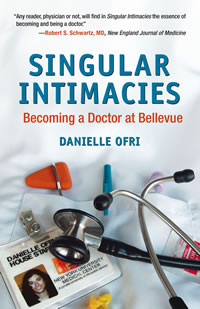
Livro: “Singular Intimacies – Becoming a Doctor at Bellevue” (1) por Danielle Ofri, 2003.
A primeira vez que ouvi falar de Danielle Ofri foi quando lium artigo seu o ano passado na revista The Lancet, que falava acerca dainterface entre a medicina e a humanística. (2)
Trata-se de uma médica internista que tem feito todo o seupercurso pré e pós graduado no hospital público mais antigo dos EstadosUnidos, e um centro de excelência, o Bellevue Hospital, localizado emManhattan, Nova Iorque. Contudo, Ofri é mais conhecida por actualmenteconciliar a sua prática clínica com a de escritora e editora, tendoinclusive criado uma revista no seu hospital dedicada à literatura, aBellevue Literary Review. Os seus artigos aparecem regularmente empublicações como o New England Journal of Medicine, Journal of theAmerican Medical Association (JAMA), The Lancet, o New York Times,etc…
Quando este ano foi reeditado o seu primeiro livro pelaBeacon Press (foi originalmente publicado pela Penguin), “SingularIntimacies – Becoming a doctor at Bellevue”, que descreve o seu percursoacadémico desde o primeiro dia como estudante de medicina dos anosclínicos até ao último dia como interna, fiquei logo com uma curiosidadeenorme em conhecer um pouco melhor o percurso de uma especialistahospitalar que aparentemente encara a medicina muito para além daperspectiva biológica, e que se aventura, e ainda bem, em grande partedevido às suas inquietudes pessoais, por caminhos mais da esferapsico-social. No fundo, como ela própria admite no livro, é a suaactividade extra-assistencial que não só lhe dá o equilíbrio emocionalque ela necessita, como também lhe enriquece a sua perspectiva damedicina.
Quando comecei a ler o livro, pensava que o grande atractivodo livro iria ser tomar contacto com um pouco da realidade de um grandeHospital Americano. Afinal de contas, como uma vez me disse oProfessor António Vaz Carneiro, os Estados Unidos ainda são o grande“farol” da medicina mundial. Por outro lado, apesar de ter decididodedicar-me aos cuidados de saúde primários, grande parte do nossointernato é realizado a nível de instituições que prestam cuidadossecundários e terciários, e portanto, a vida hospitalar também interessae deve continuar a interessar ao interno de Medicina Geral e Familiar,até porque mesmo depois do internato, muitos médicos de famíliacontinuam a exercer medicina em ambiente hospitalar, como forma decomplementar o seu trabalho no centro de saúde.
Mas havia ainda outro grande aliciante. É que o BellevueHospital é dos hospitais mais multiculturais dos Estados Unidos, e noseu Serviço de Urgência vê-se um pouco de tudo, como Ofri descreve: (…)“Turistas Europeus com malas Gucci e um quadro de intoxicação alimentar,imigrantes Asiáticos e Africanos com infecções parasitárias estranhas,indivíduos oriundos do Bangladesh com coronárias carregadas decolesterol, “Monges Tibetanos que tinham estado em greve de fome emfrente à sede das Nações Unidas” (…). Por outro lado, o HospitalProfessor Doutor Fernando da Fonseca, na Amadora, onde realizei e ondeainda continuo a fazer grande parte dos meus estágios hospitalares, étalvez o hospital em Portugal (embora numa escala muito mais pequena)que mais se aproxima à realidade multicultural tão característica doshospitais centrais das grandes metrópoles mundiais, e portanto, deu paraestabelecer alguns paralelismos com as vivências da autora, e mesmo tertido um pouco a sensação de “déja-vu”.
Ao contrário do que tinha pensado inicialmente, o que meacabou por seduzir e conquistar definitivamente à medida que iadissecando os capítulos do livro foram os relatos e desabafos quase“Balintianos” de experiências que a marcaram enquanto estudante e maistarde como médica interna. Cada capítulo do seu livro ilustra um casoque a marcou de uma forma indelével. Ofri não se limita a tecerconsiderações sobre a componente biomédica do caso, mas vai muito paraalém disso para abordar também o impacto emocional de muitos casos comque lidou ao longo de todos os anos que passou em Bellevue. Desde o seuprimeiro doente que seguiu enquanto ainda estudante de medicina, que abeijou descaradamente na enfermaria, passando pelas suas insegurançasenquanto estudante e interna, por casos doentes que suscitaram dilemaséticos quanto a opções de tratamento, ou casos de doentes compersonalidades conflituosas, Ofri vai-nos levando numa viagem queculmina na chegada à plena maturidade como médica, confiante nas suasatitudes e nos seus actos, mas perfeitamente consciente das limitaçõesda profissão médica e das fragilidades da natureza humana.
Algumas das histórias envolveram inclusive pessoas do seucírculo íntimo de amizades, como o seu grande amigo Josh, que faleceupor morte súbita aos 27 anos, bem como tutores seus, nomeadamente o casode um assistente hospitalar que tanto admirava, e que acabou por sesuicidar inesperadamente.
No fundo, cheguei à conclusão que, apesar de variarem osactores e os ambientes, os problemas encontrados por estudantes demedicina e internos de um hospital de Nova Iorque não diferirãosubstancialmente na sua essência, dos problemas com que se deparamdiariamente internos de Medicina Geral e Familiar Portugueses.
O seu livro termina de uma forma que agradará a muitosmédicos de família. Quem lesse apenas o último capítulo quase quepoderia pensar que Ofri era médica de família. Mas não, apesar detrabalhar num meio absorto na procura do diagnóstico e no fascínio datecnologia, a autora prefere destacar a importância para a práticaclínica dos momentos aparentemente banais do dia-a-dia de um clínico:(…) “embora muitas das histórias andem à volta de casos de pessoasgravemente doentes e que sofrem uma morte dolorosa e aparatosa, elas nãoilustram com justiça o amplo espectro do que significa ser médico. Sãoàs vezes as consultas mais mundanas, ou seja, aquelas que não resultamdepois em histórias dramáticas para contar, que proporcionam agratificação e sentido de realização inerente à prática médica. Osorriso na cara do doente ao ouvir que o seu nível de colesterol totalbaixou, a gratidão que o doente exprime ao receber uma receita tripla emvez de uma só, a sensação de alívio por conseguir ter encontrado umintérprete de Bengali quando estava mesmo aflita à procura de um – istosão apenas fragmentos de satisfação, mas são muito mais frequentes doque as atormentadas mortes na Unidade de Cuidados Intensivos. E estesfragmentos, quando coalescem, formam uma potente alicerce de realizaçãopessoal por dentro de mim” (…).
Caso Danielle Ofri não tivesse enveredado pela medicinainterna, teria dado certamente uma excelente médica de família e umaferverosa “Balintiana”.
Referências:
1 – Ofri, Danielle, Singular Intimacies: Becoming a Doctor at Bellevue. Beacon Press. 2009
2 – Ofri, D. The muse on the medical wards. Lancet. 2008 Jan 12;371(9607):110-1.
The first time I heard about Danielle Ofri was when I readone of her articles last year in the Lancet, which discussed theinterface between medicine and humanities.(2)
Dr Ofri is an internist who underwent both her under andpostgraduate medical training in Bellevue Hospital, the oldest publichospital in the United States, which is located in Manhattan, New York.
Dr Ofri is a well known figure for juggling her clinicalwork with being a writer and an editor, and she inclusively created aliterary journal in her own hospital called Bellevue Literary Review.
Her articles appear regularly on the pages of the NewEngland Journal of Medicine, Journal of the American Medical Association(JAMA), The Lancet, o New York Times, etc…
When this year I found out that Beacon Press had re-issuedher first book entitled “Singular Intimacies – Becoming a doctor atBellevue”, which describes her academic path since her first day as aclinical year medical student until her last day as a resident, I becamevery curious in learning a bit mote about the professional career of ahospital specialist, who, due to her personal restlessness, apparentlylooks at medicine much beyond the mere biological perspective, and veersinclusively towards the realm of the psycho-social sphere.
After all, like she admits in the book, it is hernon-clinical work that not only gives her the emotional balance sheneeds, but also enrichens her own perspective of medicine.
When I began reading the book, I thought the big appeal ofit would be learning about the reality of a big American hospital. Afterall, like Professor Vaz Carneiro once told me (aninternist/nephrologist and Professor of Medicine at the University ofLisbon), the United States are still the great “beacon” of worldmedicine. On the other hand, although I have decided to pursue a careerin primary health care, a great deal of our residency is carried out ininstitutions that provide secondary and tertiary health care. A lot offamily physicians continue to work in hospital environments afterresidency, as a way to complement their work at the health care centre.Therefore, hospital life also matters and should continue to matterto family medicine residents.
But there was still another turn-on. Bellevue Hospital isone of the most multicultural hospitals in the United States, and in theEmergency Department, one can see a bit of everything, as Ofridescries:
“European tourists with Gucci bags and food poisoning,African and Asian immigrants with strange parasitic infections, middleaged Bangladeshis with craggy cholesterol-laden coronary arteries,Tibetan monks who’d been on a hunger strike in front of the nearbyUnited Nations.”
On the other hand, Professor Doutor Fernando da FonsecaHospital, in Amadora, Greater Lisbon, where I have been doing most of myhospital rotations, is perhaps (even though on a much smaller scale)the hospital in Portugal that comes closest to a multicultural realitythat is so familiar to central hospitals in the world’s big metropolitanareas. It thus became possible to make some comparisons with theexperiences of the author, which even led me to have a bit of a“déja-vu” feeling at times.
Contrarily to what I had initially though, what ended upseducing and conquering me as I was dissecting the chapters of the bookwere the testimonials and almost “Balintian” rants regarding theexperiences that touched her as a medical student and later on as aresident.
Each chapter of her book illustrates a case that touched herin an indelible way. Ofri does not only make remarks about thebiomedical aspects of the case, but goes much beyond that in order togauge the emotional impact of many cases she dealt during the years shespent at Bellevue.
Beginning with her first patient she clerked whilst amedical student, who kissed her shamelessly on the ward, continuing withher insecurities as a medical student and a resident, the patientswhich presented with ethical dilemnas concerning their treatmentoptions, or the cases of patients with conflictive personalities, Ofritakes us on a journey that ends when she attains full maturity as aphysician, and becomes confident in her attititudes and actions, but isat the same time aware of the limitations of the medical profession andof the fragilities of human nature.
Some of the stories inclusively involved people from herintimate circle of friendships, like her friend Josh, who died of suddendeath at 27 years old, or her former tutor, an attending physician sheadmired very much and who ended up committing suicide unexpectedly.
I thus realized deep down that, even though actors andstages change, the problems faced by medical students and residents of aNew York Hospital do not substantially differ, in their essence, of thedaily problems faced by Portuguese family medicine residents.
The book ends in a way that will please many familyphysicians. Those who only read the final chapter could end up thinkingthat Ofri is a family physician. But no, despite working in anenvironment obsessed with the search for a diagnosis and the fascinationof technology, the author prefers to stress the importance of aphysician’s apparently daily routine moments for clinical practice:
“And although many of the stories revolve around gravely illpatients who die in a stark and painful fashion, these don’t completelyillustrate the full spectrum of being a doctor. It is sometimes in themost mundane clinical encounters, the ones that don’t lend themselves toa dramatic retelling, that medicine is most uplifiting. The smile onthe patient’s face upon hearing that her cholesterol has come down, thegratitude from the patient when you prescribe a three-month supply ofpills instead of a one-month supply, the triumph of finding a Bengaliinterpreter when you need one – these are but splinters of satisfaction,but they are evermore common than the tormented deaths of the ICU. Andthese splinters, when coalesced, form a potent girder of fulfillmentbeneath me.”
If Danielle Ofri had not decided to pursue internalmedicine, she would have made a great family doctor, as well as anardent “Balintian”.